
A connected game design system with AI

Your game design, connected, synchronized, and enhanced by AI

One GDD that stays alive as your game changes.

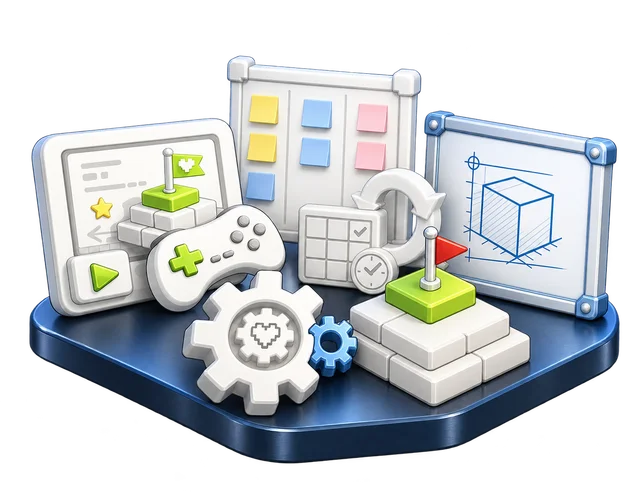
Mainloop links mechanics, systems, levels, tasks, and decisions in one GDD. Each module can be worked on separately or viewed inside the complete system; AI helps structure, review, and maintain consistency as the game changes.

Connected design

Each module stands alone and remains part of the systemThe same information can be reviewed as modules, relationships, coverage, and risks without leaving the GDD.
Coverage87%
Connections4
Risks3

One GDD · Connected modules · Complete graph · Synchronized changes

Modules for designing every part of the game

Mainloop organizes design using the same categories as the app: Base, Design, Levels, and Development. Each module can evolve without forcing you to rewrite the whole GDD.

Choose a module to explore which decisions should be defined and connected.

Defines the first playable base: scope, test, hypothesis, and the minimum needed to validate the idea.

Base

Design

Levels

Development

Validate the full design

Essentials

The base that keeps concept, intent, rules, spaces, and development decisions aligned.

Real problems when designing a game

The design loses consistency with every change

Problem

When a mechanic changes, systems, levels, progression, and rules may change too. If the GDD does not show those connections, the design can start breaking without it being obvious.

How Mainloop solves it

Mainloop helps keep those decisions connected so you can review which parts of the design are affected.

Ideas spread across too many places

Problem

Notes, chats, documents, references, and old versions make understanding the real state of the design take more energy than designing.

How Mainloop solves it

Mainloop centralizes design in clear modules so the GDD stays useful during iteration.

The GDD stops representing the real game

Problem

A static GDD becomes obsolete when the design changes. If nobody updates it, it stops being a design tool.

How Mainloop solves it

Mainloop keeps the GDD alive, editable, and connected to the real creative process.

How it works

From the individual module to the complete system

Mainloop organizes the design in one modular GDD. Decisions relate to each other, changes return to the same source, and the team can view both each module's detail and the complete design.
  1. Idea
  2. GDD
  3. Validation
  4. Prototype
  5. Tasks
  6. Iteration
01

Capture the idea

Start from a premise, playable fantasy, references, or a playable test.

02

Structure the GDD

Organize essentials, loops, mechanics, systems, levels, and open decisions into clear modules.

03

Validate coherence

Review contradictions, weak links, risks, and design areas that need more definition.

04

Move into tasks

Turn mature decisions into tasks, exportable context, and useful material for development.

05

Iterate without losing source

What changes in prototype or development returns to the GDD so it stays alive.

06

Share clarity

Use one visual, modular source to align design, levels, and development.

Read the GDD and LDD guide

Roles

How different roles use Mainloop

The same living GDD acts as a shared source, but each role needs to inspect decisions, risks, and modules from a different angle.
How do you work on design?

Structure decisions, mechanics, and systems inside a Game Design Document that evolves with the game.

Game design

For people who design games

Organize intent, loops, mechanics, systems, and open questions without losing how each decision relates to the rest.

  • Define pillars and core loop
  • Turn ideas into rules
  • Review coherence across systems
Level design

Level designers

Connect areas, levels, blockouts, puzzles, and pacing with the rest of the GDD so every space has intent.

  • Define level goals
  • Relate layout and mechanics
  • Validate progression and pacing
Development

Game developers

Receive clearer rules, dependencies, and decisions before implementing features or preparing a technical base.

  • Understand feature intent
  • Detect dependencies
  • Move decisions into tasks
Learn how to structure a GDD

Downloadable resources

Learn to document a game with practical guides, templates, and examples. Bring what you learn from prototypes and playtests back into a GDD that keeps evolving.

Documentation

01

GDD + LDD guide

Learn what a Game Design Document is, what a Level Design Document is, and how to structure useful documentation.

Read the guide

Product downloads

02

Mainloop workflow

A visual guide for moving from an early idea to design, documentation, validation, and iteration without losing context.

03

Mainloop for connected game design

A short reference for organizing intent, loops, mechanics, systems, and open decisions inside the GDD.

04

Mainloop for level designers

A compact guide for connecting areas, levels, blockouts, puzzles, and pacing with the broader game intent.

05

Mainloop for developers

A summary for turning design decisions into rules, dependencies, and clear context before implementation.

Why game design needs to evolve

Mainloop

01When a game grows, design becomes fragmented. Ideas stay in notes, mechanics change, systems contradict each other, and levels lose intention.

02The problem is not writing more documentation: it is keeping a clear source of decisions.

03Mainloop exists to sustain that clarity. It does not replace the designer’s judgment.

04It makes it more visible, organized, and easier to review.

The same GDD stays with the game to preserve decisions, relationships, and context.

GDD Memo mini game about game design concepts

Follow me on LinkedIn

Real processes, design decisions, and lessons from building Mainloop

Game design without the hype

Experiments, mistakes, and frameworks applied to game design, systems, and connected GDDs

Follow on LinkedIn

These links prepare an email to support to request withdrawal from a purchase or cancellation of a subscription.

Add the information you have and send the message from your email app. The request goes to soporte@mainloop.ai.